

Is Stainless Steel Jewelry Magnetic? 2025-10-15
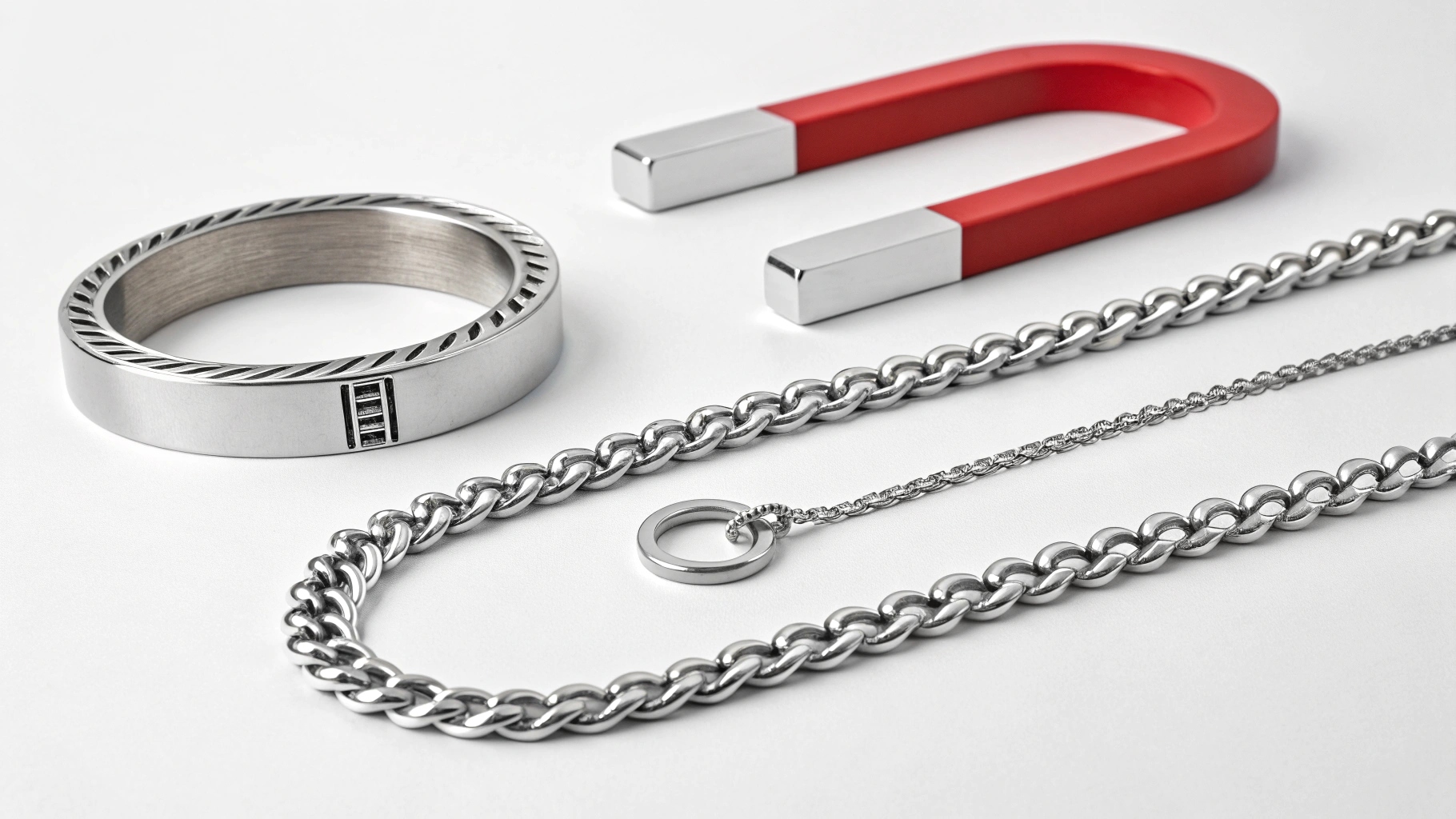
Table of Contents
🧲 Is Stainless Steel Jewelry Magnetic or Not?
Quick answer: Most stainless steel jewelry isn’t magnetic — but some pieces can be slightly magnetic, depending on the type of steel used.
Let’s dive into the why and how 👇
🌟 Why People Ask This Question
If you’ve ever noticed your stainless steel ring or necklace stick to a magnet (while another one doesn’t), you’re not alone. Many jewelry lovers wonder what that means — is one fake? Is it low quality?
The truth is simple: magnetism in stainless steel jewelry depends on its metal composition.
Understanding this not only satisfies curiosity but also helps you choose jewelry that fits your needs for durability, comfort, and skin safety.
🧬 The Science Behind Stainless Steel
Stainless steel isn’t a single metal — it’s a blend (alloy) of several elements like iron, chromium, nickel, and sometimes manganese or molybdenum. These combinations give stainless steel its signature shine, toughness, and resistance to rust.
But here’s where it gets interesting:
Different combinations create different grades of stainless steel, and some of them are magnetic while others aren’t.
Let’s look at the main types:
-
Austenitic Stainless Steel (e.g., 304, 316L)
-
The most common type used in jewelry.
-
Non-magnetic or only slightly magnetic.
-
Highly resistant to corrosion and hypoallergenic — great for sensitive skin.
-
-
Ferritic & Martensitic Stainless Steel (e.g., 410, 420)
-
Contains more iron and less nickel.
-
Magnetic by nature.
-
Commonly used in tools or lower-cost jewelry.
💍 How to Tell If Your Jewelry Is Magnetic
Here’s a simple test you can try at home:
Take a small magnet and hold it close to your jewelry.
-
If it doesn’t stick, your piece is likely made from 316L or 304 stainless steel, both considered high-quality and non-magnetic.
-
If it sticks slightly or strongly, it might be made from a magnetic grade like 410 or 420 — still stainless steel, just with a different metal mix.
👉 Pro tip: Even top-quality 316L stainless steel can show slight magnetism after certain manufacturing steps, like polishing or shaping. So don’t panic if there’s a tiny pull — it doesn’t mean it’s fake!
⚙️ Magnetic ≠ Fake
A common myth is that magnetic jewelry must be fake.
That’s not true at all.
Magnetism only tells you about the crystal structure inside the steel — not whether it’s genuine. Both magnetic and non-magnetic stainless steels are real, just made differently.
So if your bracelet sticks to a magnet, don’t assume the worst. It’s still real stainless steel — just with a different personality 😄.
🧡 The Bottom Line
-
Most stainless steel jewelry (316L) is non-magnetic.
-
Some grades may show mild magnetism, and that’s totally normal.
-
Magnetism doesn’t define quality — composition and craftsmanship do.
Next time you grab a magnet to test your favorite chain, remember: the result doesn’t reveal “real” or “fake” — it just shows a bit of fascinating metal science at work 🔬.
🧾 FAQ
Q: Is magnetic stainless steel bad quality?
A: Not necessarily. It simply contains more iron. But 316L stainless steel — which is usually non-magnetic — is preferred for its smooth feel and resistance to rust.
Q: Can stainless steel jewelry turn my skin green?
A: No. Unlike cheaper alloys, stainless steel won’t tarnish or react with your skin.
Q: Is stainless steel jewelry better than silver?
A: It depends on your lifestyle! Stainless steel is tougher and more affordable, while silver has a softer, more classic look.
- Company Info
- Customer Reviews
- About Us
- Contact Us
- Blog
- User Center
- Forget Password
- My Orders
- Tracking Order
- My Account
- Register
- Payment & Shipping
- Customs & Taxes
- Locations We Ship To
- Payment Methods
- Contact Us
Address: #5 Shuitian village, Shiyan Town, Bao an District, Shenzhen, China.
Business Hours : 9:00 AM-6:00 PM
Email: info@jclovejewelry.com
 Leave a message